




UAE Investors Pioneer AI Adoption but Humans Make the Final Call
New HSBC research - AI is supporting UAE investors with better insights, 63% say it makes them more willing to take better-calculated risks
Investors in the UAE are among the world’s most enthusiastic adopters of artificial intelligence, including generative AI, using it to research and generate finance and investment ideas — yet they still want the judgement of a professional adviser when it is time to act, according to new HSBC research.
Findings from HSBC’s ‘The Human-AI Advantage’ report — a survey of 9,993 affluent and high-net-worth individuals across 10 markets, including 703 in the UAE — point to a new hybrid workflow: AI accelerates discovery and analysis, while advisers provide context, validation and accountability at the point of commitment. The UAE consistently sits at the leading edge of that shift.
These insights come as HSBC scales AI to support human advice in wealth. This includes the continued rollout of Wealth Intelligence, an LLM-powered platform drawing on more than 10,000 data sources including HSBC research and external news feeds. It synthesises information in real time, designed to help Relationship Managers arrive at client conversations better prepared, surface relevant insights faster, and spend more time on the personalised guidance clients value most.
The findings land at a moment of accelerating national AI ambition. The UAE National Strategy for Artificial Intelligence 2031 positions AI as a central pillar of economic diversification, while the recently approved Artificial Intelligence and Data Authority brings the country’s data, AI and digital-government capabilities under a single national framework — reinforcing the UAE’s standing as one of the world’s most AI-forward economies.
UAE: a global frontrunner in AI adoption
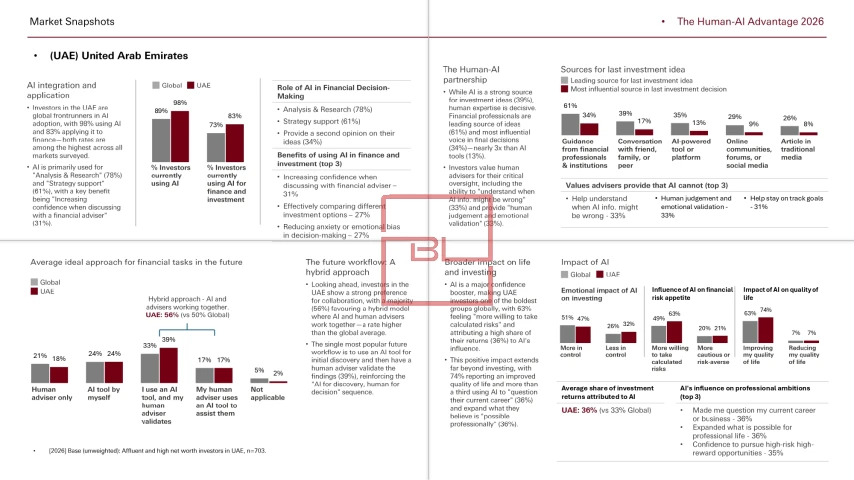
Investors in the UAE are global frontrunners in AI adoption. 98% use AI across their lives — the joint-highest of all ten markets surveyed, alongside India, and well ahead of the UK (76%) and US (75%) — and 83% use it specifically for finance and investment, against 73% globally. They turn to AI most for analysis and research (78%) and strategy support (61%, the second-highest of any market), and value it most for increasing their confidence when discussing options with a financial adviser (31%), comparing investment options (27%) and reducing anxiety or emotional bias in decision-making (27%).
AI makes UAE investors bolder
AI is reshaping risk appetite in the UAE more than almost anywhere. 63% of UAE investors say AI supports them to take better-calculated risks — second only to India (64%), and well above the 49% global average and every Western market surveyed (US 44%, UK 39%). UAE investors also attribute a high share of their returns to AI — an average of 36% over the past 12 months, among the highest of any market (global average 33%) .
Where exploration ends and expertise begins
Greater confidence has not displaced the adviser. When UAE investors look to the future, a majority (56%) prefer a hybrid model in which AI and human advisers work together — above the 50% global average — and their single most preferred workflow, at 39% (the joint-highest of any market), is to use AI for initial discovery and then have a human adviser validate the findings before acting.
That preference is reflected in where decisions are actually made: financial professionals and institutions are the leading source of UAE investors’ last investment idea (61%) and the most influential voice in their final decision (34%) — nearly three times the influence of AI tools (13%). UAE investors most value advisers for the things AI cannot do: helping them understand when AI-generated information might be wrong (33%), providing human judgement and emotional validation (33%), and helping them stay on track to their goals (31%).
Barry O’Byrne, CEO of International Wealth & Premier Banking at HSBC, explains:
“Clients aren’t choosing between AI and professional advice – they’re sequencing both. AI is helping clients explore faster, but when they reach the moment of decision, they want a trusted human checkpoint for context and validation. That is why we are accelerating adviser-enabled AI in wealth, including Wealth Intelligence – bringing together HSBC research and external information, so our Relationship Managers have timely insights and can focus on what clients value most: emotional and practical support that leads to better decisions and stronger outcomes.”
Craig Worobec, Head of Wealth & Premier Solutions, UAE & Middle East, HSBC, adds:
“The UAE is one of the most AI-fluent societies in the world, and our research shows that ambition runs right through to how people invest. UAE investors are among the world’s most confident users of AI — and among the boldest — yet they tell us clearly that they still want a trusted human checkpoint before they commit. That is exactly the model we are building here: pairing the speed and breadth of AI with the judgement of an experienced adviser, so clients can act with both confidence and conviction. As the UAE advances its national AI ambitions, we want our clients to feel the benefit of that progress in their own financial lives.”
AI builds confidence — advisers provide conviction
AI is changing how UAE investors feel about investing, and its impact reaches well beyond their portfolios. 74% say AI is improving their quality of life — well above the 63% global average — and more than a third say it has expanded what they believe is possible professionally (36%), prompted them to question their current career or business (36%), or given them the confidence to pursue high-risk, high-reward opportunities (35%).
Even so, the boldest investors still want human judgement. While AI builds the confidence to consider more, the conviction to act continues to come from a trusted adviser — underlining why the UAE’s most AI-confident investors still place a human at the centre of their most important financial decisions.
Comments